Thursday, 5 February 2009

Storyboard for our opening sequence

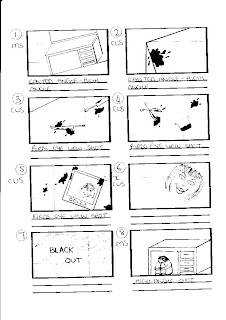
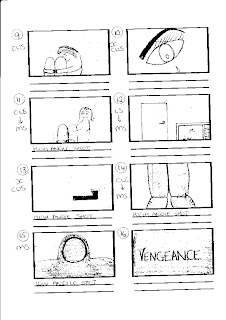
Before we started filming we had to create a storyboard to follow. As a group we put together this storyboard for our opening sequence and this will hopefully help us when filming and give us an outline of which to work with.
This was our first draft storyboard


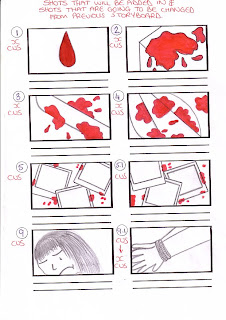
After looking at the first draft of our storyboard we looked at ways in which we can improve the shots in order to make them more appealing and affective towards our audience. These are some of the shots we have added and changed in our sequence. For example, the first four shots we have decided to use extreme close up shots in order to emphasis on the blood and brutality of the tools on the table. Little aspects of our opening sequence such as these, will make a great change on the overall affect and therefore we have chosen to alter a few things (which are shown in the storyboards below) in order to make our opening sequence more enhanced. 

Drawing by Zulaikha Khan


Monday, 2 February 2009

Film Editing

Film editing is an art of storytelling practiced by connecting two or more shots together to form a sequence, and the subsequent connecting of sequences to form an entire movie. Its the work of selecting and joining together shots to create a finished film. Film editing is the only art that is unique to cinema and which separates film making from all other art forms. Editing is the art, technique, and practice of assembling these shots into a consistent whole.A film editor works with the layers of
  •  Images
  •  Story
  •  Music
  •  Rhythm
  •  Pace
  •  Shapes
  •  Actors Performances
  •  Re-directing 
  •  Re-writing the film during the editing process
Film editing can be used in various ways:
  1.  It can create sensually provocative montages
  2.  It can bring out the emotional truth in an actor's performance
  3.  It can create a point of view on otherwise obtuse events
  4.  It can guide the telling and pace of a story
  5.  It can create the illusion of danger where there is none
  6.  Surprise when we least expect it
  7.  A vital subconscious emotional connection to the viewer.
film editor is a person who practices film editing by assembling footage into a coherent film. Film editors often are responsible for pulling together all of the elements of story, dialogue, music, sound effects, visual effects, rhythm and pace of a film. 

There are various types of editing used in film making to make the film look more effective and realistic, cuts and transitions and other different types of editing techniques are used in films to make it look original.  The different types of film editing techniques are:

Cut 
A visual transition created in editing in which one shot is instantly replaced on screen by another.

Cross cutting
Cutting back and forth quickly between two or more lines of action, indicating they are happening simultaneously.


Dissolve 
A gradual scene transition. The editor overlaps the end of one shot with the beginning of the next one.


Establishing shot 
A shot, normally taken from a great distance or from a "bird's eye view," that establishes where the action is about to occur.


Fade 
A visual transition between shots or scenes that appears on screen as a brief interval with no picture. The editor fades one shot to black and then fades in the next. Often used to indicate a change in time and place.


Wipe 
Visible on screen as a bar travelling across the frame pushing one shot off and pulling the next shot into place.


Final cut 
The finished edit of a film, approved by the director and the producer. This is what the audience sees.

Famous Directors

A film director or filmmaker, is a person who directs the making of a film. A film director visualizes the script, controlling a film's artistic and dramatic aspects, while guiding the technical crew and actors in the fulfillment of his or her vision. A film director is responsible for overseeing creative aspects of a film. They often develop the vision for a film and carry out , deciding how the film should look. They also direct which tone it should have and what the audience should gain from the cinematic experience . Directing a film is a kind of storytelling. Film directors are responsible for approving camera angles, lens effects, lighting, and set design, and will often take part in hiring key crew members. They coordinate the actors' moves and also may be involved in the writing, financing and editing of a film.

The greatest FILM DIRECTORS of all time are:
  • Mel Brooks
  • Steven Spielberg
  • George Lucas
  • Peter Jackson
Mel Brooks- was born on june 28, 1926 in brooklyn New York. His name was Mclvin Kaminsky. He is a actor, writer, comedian, and a producer. He received many awards for his films. In 1963 he received an Oscar for best animated short; The Critic. In 1966 an Emmy for outstanding writing achievement in variety, The Sid Caesar, Imogene Coca, Carl Reiner, Howard Morris special. In 1968 he won an Oscar for best screenplay in The Producers. In 1997, 1998, and 1999 he gained an Emmy for outstanding guest actor for Mad About You. In 1999 he received a Grammy for best spoken comedy album for The 2000 Year Old Man In The Year 2000. His latest award in 2001 was a Tony for the best musical for The Producers. Mel Brooks has truly had a great career.


Steven Spielberg- Steven Spielberg was born on December 18th 1946 in Cincinnati, Ohio. His mother was Leah Adler, and his father was Arnold Spielberg. Steven is also a screenwriter and producer. In 2008, the magazine Premiere listed him as the most powerful and influential figure in the Motion picture industry. In a career of over four decades, Spielberg's film have touched on many themes and genres. Spielberg's early sci-fi and adventure films, sometimes centering on children, were seen as an archetype of modern Hollywood blockbuster filmamking. In later years his movies began addressing such as the Holocaust, slavery, war and terrorism . Speilberg won the academy Award for Best Director for 1993's Schindler's List and 1998's Saving Private Ryan. Three of Spielberg's films, Jaws(1975), E.T. the Extra-Terrestrial (1982), and Jurrasic Park (1993), broke the box office records, each becoming the highest- grossing film made at the time. To date, unadjusted gross of all Spielberg directed film exceeds $8.5 billion worldwide.
Jurassic Park (Widescreen Collector's Edition)

George lucas- George Walton lucas was born on May 14th 1944. He is an Academy Award-nominated American film director, producer, screenwriter and chairman of Lucas film Ltd. He is best known for being the creator of the epic Sci-Fi franchise Star Wars and the archaeologist adventurer character Indiana Jones. Lucas is one of the American film industry's most financially successful independent directors/producers, with an estimated net worth of $3.9. billion.


Peter Jackson- Peter Robert Jackson was on born 31 October 1961 and is a three time Academy Award winning New Zealand filmmaker, producer and screenwriter, best known for The Lord of the Rings trilogyadapted from the novel by J. R. Tolkien. He is also known for his 2005 remake of King Kong. He won international early in his career with his "slapstick" horror comedies, before coming to mainstream prominence with Heavenly Creatures, for which he shared an Academy Award best screenplay nomination with his partner Fran Walsh.


Tuesday, 27 January 2009

Camera shots

The framing of the shot creates what we see on the screen. Choices about the framing of a shot change the shots meaning. Sometimes it is important to frame a shot from the different heights to change the audience's perspective on the material. The camera could be positioned close to the floor, shooting straight-on to give the impression of a low height. Perhaps this would be used to signify the view of a child or small creature. Furthermore changing the camera distance supplies a sense of us being close to or far away from the material of the shot. the standard measure of camera distance is the scale of the human body.

Extreme Wide Shot
Extreme Wide Shot
The extreme wide shot, the view is so far from the subject that she isn't even visible. The point of this shot is to show the subject's surroundings. The Extreme wide shot is often used as an "establishing shot" the first shot of a new scene, designed to show the audience where the action is taking place.


Long Shot
A shot that shows a character at a distance, spanning their whole height but leaning an area above and below them. this focuses the audience's attention on the character and their surroundings.


Medium Shot
Also known as a mid shot, this shows a character from the knees or waist up or full length seated figure. Most effective for showing the interplay between two characters and bridging the gap between a wide shot and a close-up. This shot can also be adapted to a medium long shot or a medium close-up.


Close-up
Used to show extreme detail or facial expressions. A character is framed from jus beneath the shoulders with space left above the head. This shot is effecitve for showing an audience a character's emotions and reactions because it focuses their concentraion on only one thing on the screen.


Extreme Close up
This shows only part of the head, the area from the lips to the eyes, and is often used for highly emotional shots to increase dramatic effect.


Over the shoulder shot
A shot made from over the shoulder of a character, focusing on what he or she is seeing.


Point of view shot
Seen from the character's point of view

Storyboards

What are Storyboards and where were they originally used

Storyboards are graphic organizers such as a series of illustrations or images displayed in sequence for the purpose of previsualizing a motion graphic or interactive media sequence, including website interactivity. The storyboarding process can be very tedious and intricate. The form widely known today was developed at the Walt Disney studio during the early 1930s.

Here are a few examples of storyboards...

Its Usage

A film storyboard is essentially a large comic of the film or some section of the film produced beforehand to help film directors, cinematographers and television commercial advertising clients visualize the scenes and find potential problems before they occur. Often storyboards include arrows or instructions that indicate movement.
In creating a motion picture with any degree of fidelity to a script, a storyboard provides a visual layout of events as they are to be seen through the camera lens. And in the case of interactive media, it is the layout and sequence in which the user or viewer sees the content or information. In the storyboarding process, most technical details involved in crafting a film or interactive media project can be efficiently described either in picture, or in additional text.
Alfred Hitchcock's films were strongly believed to have been extensively storyboarded to the finest detail by the majority of commentators over the years, although recent research indicates that this was exaggerated for publicity purposes. Other directors storyboard only certain scenes, or none at all. Animation directors are usually required to storyboard extensively, sometimes in place of doing a script.

Advantages

One advantage of using storyboards is that it allows the user to experiment with changes in the storyline to evoke stronger reaction or interest. Flashbacks, for instance, are often the result of sorting storyboards out of chronological order to help build suspense and interest.
The process of visual thinking and planning allows a group of people to brainstorm together, placing their ideas on storyboards and then arranging the storyboards on the wall. Furthermore Storyboards for films are created in a multiple step process. They can be created by hand drawing or digitally on the computer.

How to create a storyboard

If drawing by hand, the first step is to create or download a storyboard template. These look much like a blank comic strip, with space for comments and dialogue. Then sketch a "thumbnail" storyboard. Some directors sketch thumbnails directly in the script margins. These storyboards get their name because they are rough sketches not bigger than a thumbnail. For some motion pictures, thumbnail storyboards are sufficient.
However, some filmmakers rely heavily on the storyboarding process. If a director or producer wishes, more detailed and elaborate storyboard images are created. These can be created by professional storyboard artists by hand on paper or digitally by using 2D storyboarding programs. Some software applications even supply a stable of storyboard-specific images making it possible to quickly create shots which express the director's intent for the story. These boards tend to contain more detailed information than thumbnail storyboards and convey more of the mood for the scene. These are then presented to the project's cinematographer who achieves the director's vision.
Finally, if needed, 3D storyboards are created (Technical Previsualization). The advantage of 3D storyboards is they show exactly what the film camera will see using the lenses the film camera will use. The disadvantage of 3D is the amount of time it takes to build and construct the shots. 3D storyboards can be constructed using 3D animation programs or digital puppets within 3D programs. Some programs have a collection of low resolution 3D figures which can aid in the process. Some 3D applications allow cinematographers to create "technical" storyboards which are optically-correct shots and frames.
Lighting

Backing in the early days of cinematography, lighting was always a natural source used when filming. Studio roofs would be opened in order to allow sunlight in and give a good effect for the scene. As time moved on, and technology as well as film developed and the production of films widened, the need of appropriate artificial technology was needed. the use of artificial lighting became more common and this helped the film industry develop worldwide. From the start, lighting was a key part of film making and played a substantial part in the narrative.
Some genres often stick to natural and standard lighting in order to give a more neutral realistic feel. Others however, use lighting as a means of creating much greater experimental effect. Some genres such as sci-fi and horror use lighting in a much more different and unique way, where possible and this gives a more adventurous feel.


Some different key lighting often used in filming:

Three point lighting – this is standard mainstream lighting often used in films and also on the TV. This is where three different lights are used: key, fill and back. The intensity of these lights can be altered in order to create different effects.

High key lighting/soft lighting – this is where the key light is brighter than the fill light and this makes the object appear brighter and softer.

Low key lighting/hard lighting – here the fill light is brighter and stronger than the key light; this results in dark shadows on the object.

Back lighting - This technique is very often used in thriller and horror films in order to show the more dominant characters or slayers and killers. The subject is only lit from the back and this creates a silhouette effect. The features of the person are not visible and this is an important style of lighting we will be using in our opening sequence to show the slayer.

Side lighting – this highlights the subject from only one side showing the subject distorted and imbalanced.

Frontal lighting – this shows the image as being very flat.

Ambient lighting is a term used in order to describe the use of light in a certain way to create a definite mood or emotion. This lighting is only used very subtly but still enough to create and effective outcome.

In order to achieve good results in filming, you need to use different sources of light and firstly get acquainted with the way they work. There is now a greater range of lighting that can be used when filming and this giving a greater range of effects. By changing the intensity, position and number of these lights, different motions of lighting can be obtained. There are different tips and techniques that can be used when using lighting, but the basic need is to become familiar with what is known as three-point lighting; this consists of the key light, fill light, and back light. Once you are familiar with this technique it will allow you to be able to distinguish the difference between 'good' and 'bad' lighting.

Camera Angles

Camera angles can be seen as vaguely different things to different people but overall refer to the way a shot is composed. The camera angle is mainly seen as the angle of which the camera is relative to the subject/character. The link between both camera and object being photographed is what gives the audience emotional information about the character and also helps in the way the character or object is portrayed in the shot. The more natural and straight angled the shot, the more realistic and natural the scene, but the more extreme the angle, the more symbolic and intense the information.

Here are different examples of a few widely used examples…


Birds eye view – this shows the scene from an overhead shot, almost as if a bird was viewing the scene from above. It is a very unnatural and strange angle and objects viewed from this angle are not always recognisable at first until concentrated on. At times this may be to show that the audience has greater power over the object/characters and to make characters look insignificant

High angle – these often show the object as being vulnerable and weak however are not as extreme as a birds eye view. The scene is shot from a higher level from the object possibly showing them as smaller and less significant.


Low angle – these shots tend to give the object connotations of power and dominance. Low angles tend to give a sense of confusion to the audience and show the object as being dominant than the audience. These increase the height and weight of the object in the shot. The background of a low angle shot often shows the surrounding of the character for example the ceiling of a building or the sky.

Oblique/canted angle – these make the object or person being shot seem obscure. This is where the camera is tilted to suggest imbalance, transition and instability.


Eye level this is a neutral shot where the camera is positioned at the same level of the object or character. It is often positioned as though a human is watching the scene itself.


  • Camera angles are a major tool that can help shape the look and feel of the film. As mentioned before the camera angle marks the specific location at which the camera is placed to take a shot. where the camera is placed in relation to the object effects the way in which the audience perceive the object. A low angle shot would show the object as dominant and powerful and a high angle shot would show the object as weak and vulnerable. Just like this, a natural eye-level shot would have no effect on the audience as it is as if the viewer is present there.